The Mathematics of Entrepreneurship

Making Entrepreneurship
a Good Game

The maths behind reaching $10,000 a month in recurring revenue — and why AI changes the odds.

Introduction

Most people believe entrepreneurship is about having the best idea, working the hardest, having the biggest budget or being the smartest person in the room.

I don't think that's true.

Chris Needham
Chris Needham (Founder)

After 22 years as an entrepreneur, I believe entrepreneurship is fundamentally a game of probability.

Today I'm going to prove that mathematically.

More importantly, I'm going to prove that Artificial Intelligence has fundamentally changed the mathematics of entrepreneurship.

Our target

Success = $10,000 MRR → Reward (R) = $360,000

Throughout this page, "success" means building a business that reaches $10,000 in monthly recurring revenue (MRR).

The Old Story

For decades we've been told the same story.

Come up with a brilliant idea.

Work harder than everyone else.

Raise more money.

Hire better people.

And eventually you'll succeed.

But if that were true, the hardest-working or best funded or smartest entrepreneurs would win.

They don't.

Business history is full of incredible ideas that failed and ordinary ideas that became billion-dollar companies.

Why?

Why Timing Matters

For me, the reasons for that lies in a case study in 2015 by Bill Gross the founder of IdeaLab whose TED Talk, analyzed his portfolio of 200 start ups to uncover why some thrived and others failed.

He looked at the usual suspect. The team, the idea, the business model and funding. But the results he found surprised even him. Even though each of those elements were an important aspect to success he found that timing alone accounted for roughly 42% of the variance. Making it the single most decisive factor.

Basically you can have the best idea in the world but if the market is not ready, you will fail. Conversely, even a modest idea can succeed if introduced at exactly the right moment.

And that is why entrepreneurship is so hard.

Every business is an experiment.

Every product launch.

Every marketing campaign.

Every sales process.

Every new idea.

Every one is simply another attempt to discover whether the market says yes or no. Whether you have the right business at the right time for the right group of people.

That means entrepreneurship isn't a game of certainty.

To be an entrepreneur you are participating in a game of repeated experiments.

And mathematics has been studying repeated experiments for hundreds of years.

With the two main ones being the probability equation and the good game criterion.

The Probability Equation

Now you have all heard of the probability equation.

It simply means this:

The more attempts you make, the less likely you are to fail completely.

P(≥1) = 1 − (1 − p)ⁿ

Think about flipping a coin.

Flip it once and you have a 50% chance of getting heads.

Flip it twice and your chance of getting at least one head jumps to 75%.

Flip it ten times and your probability exceeds 99%.

Nothing about the coin changed.

The only thing that changed was the number of attempts.

Business works exactly the same way.

The entrepreneur who can afford one attempt has one chance.

The entrepreneur who can afford twenty high-quality attempts has a completely different probability of success.

That brings us to a second equation that almost nobody in entrepreneurship talks about.

The Good Game Criterion

The Good Game Criterion doesn't ask, "What is the probability of you succeeding?"

It asks a much better question.

"Is this a game worth playing?"

This equation is even simpler.

GGC = (P × R) − C

Where:

  • P is the probability of success.
  • R is the reward if you succeed.
  • C is the cost of trying.

If the result is positive, you're playing a mathematically good game.

If it's negative, you're playing a mathematically bad one.

And here's the breakthrough.

Artificial Intelligence doesn't have to make you smarter.

It doesn't have to give you a better idea.

It doesn't even have to increase your probability of success.

It only has to reduce one variable. Cost.

Because every dollar removed from the cost of building, testing and launching a business changes the mathematics.

Lower costs mean more attempts.

More attempts increase your probability of success.

And for the first time in history, those two equations are moving in the entrepreneur's favour at the same time.

That's why I don't believe AI is simply another technology. I believe it is the greatest opportunity of our lifetime because it has fundamentally changed the mathematics of entrepreneurship.

And over the next few minutes, I'm going to prove it.

Defining Reward

Before we can apply the Good Game Criterion to a mathematical table. Full disclosure, we need one assumption.

We need to define what Reward looks like.

For this presentation, I'll define a successful business — i.e. the reward — as one generating $10,000 in Monthly Recurring Revenue.

$10,000/mo × 12 months = $120,000 ARR

$120,000 × 3× valuation = $360,000 reward

We use enterprise value as a proxy for reward; your actual outcome may be ongoing cash flow, a sale, or both. The 3× ARR multiple is our working assumption.

From this point on, every calculation uses the same reward:

R = $360,000

The only things we'll change are the probability of reaching $10,000 MRR and the cost of building and launching one attempt.

Now, you might ask, "What percentage of businesses actually reach $10,000 a month?"

The honest answer is—we don't know.

Governments measure how many businesses survive. They don't measure how many reach a specific revenue target. So rather than pretending we know the answer, we're going to do what mathematicians do when the true probability is unknown.

We'll test every possibility.

The Mathematics in Practice

We'll start with an incredibly difficult environment where just 0.5% of businesses reach $10,000 MRR, then increase the assumed success rate to 1%, 2%, 5%, 10%, 20% and beyond.

For every success rate, we'll calculate the Good Game Criterion using exactly the same reward of $360,000, while reducing only one variable—the cost of launching the business.

We don't know the true probability that any given business reaches $10,000 MRR — so this table is a sensitivity analysis, not industry data.

Here's what we find.

Expected value per attempt to reach $10,000 MRR: (P × $360,000) − C. P = probability of reaching $10,000 MRR; C = cost to build and launch one attempt.

P (reach $10k MRR)$1,000 Launch Cost$5,000 Launch Cost$10,000 Launch Cost$20,000 Launch Cost
0.5%$800-$3,200-$8,200-$18,200
1.0%$2,600-$1,400-$6,400-$16,400
1.5%$4,400$400-$4,600-$14,600
2.0%$6,200$2,200-$2,800-$12,800
2.5%$8,000$4,000-$1,000-$11,000
3.0%$9,800$5,800$800-$9,200
4.0%$13,400$9,400$4,400-$5,600
5.0%$17,000$13,000$8,000-$2,000
6.0%$20,600$16,600$11,600$1,600
7.0%$24,200$20,200$15,200$5,200
8.0%$27,800$23,800$18,800$8,800
9.0%$31,400$27,400$22,400$12,400
10.0%$35,000$31,000$26,000$16,000
15.0%$53,000$49,000$44,000$34,000
20.0%$71,000$67,000$62,000$52,000
25.0%$89,000$85,000$80,000$70,000
30.0%$107,000$103,000$98,000$88,000
40.0%$143,000$139,000$134,000$124,000
50.0%$179,000$175,000$170,000$160,000

Positive values = mathematically good game. Negative values = expected loss per attempt. The table models one attempt; lower costs also let you run more attempts (see Graphs in Practice).

Even if only 2% of businesses ever reach $10,000 MRR, a business costing $20,000 produces an expected loss of $12,800.

Reduce the cost to $10,000, and the loss almost disappears to $2,800.

Reduce it again to $5,000, and the same business becomes profitable, with an expected value of +$2,200.

Reduce the cost to just $1,000, and the expected value rises to +$6,200.

Nothing about the entrepreneur changed.

Nothing about the business idea changed.

Nothing about the probability of reaching $10,000 MRR changed.

The only thing that changed was the cost of making an attempt.

The break-even calculations tell exactly the same story.

A business costing $20,000 needs a success rate of 5.56% just to break even.

At $10,000, that falls to 2.78%.

At $5,000, it falls again to 1.39%.

And at $1,000, a business only needs to succeed 0.28% of the time to become mathematically rational.

The Breakthrough

That's the breakthrough.

Artificial Intelligence doesn't have to make entrepreneurs smarter.

It doesn't have to improve their ideas.

It doesn't even have to increase their probability of success.

It only has to reduce the cost of trying.

And once the cost falls far enough, entrepreneurship stops being a mathematically bad game and becomes a mathematically good one.

And that is what nomorestaff is about. Creating AI employees that can be easily integrated into your Claude, n8n, make or any other application you need to build and run businesses focusing strictly on the cost saving for experimentation to increase the likelihood of businesses playing a good game.

Graphs in Practice

Let's apply that theory into graphs.

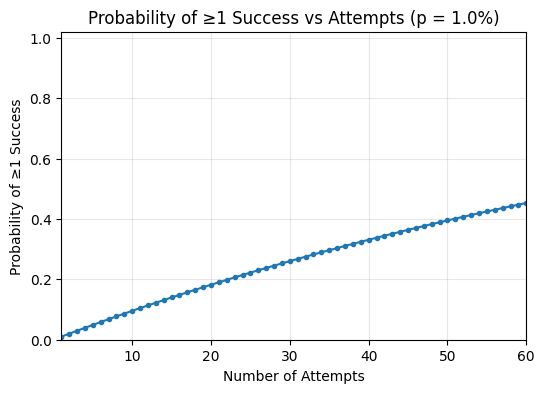
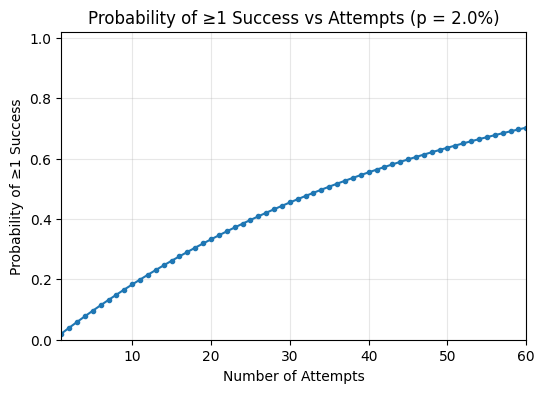
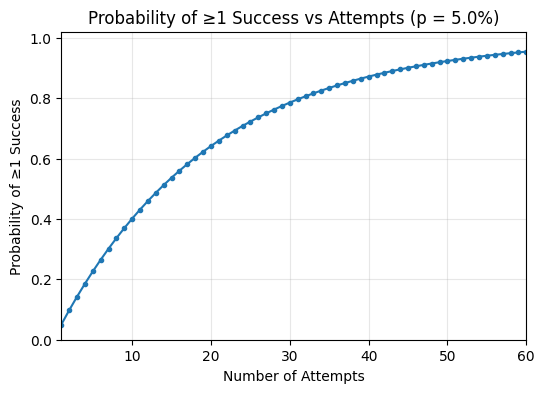
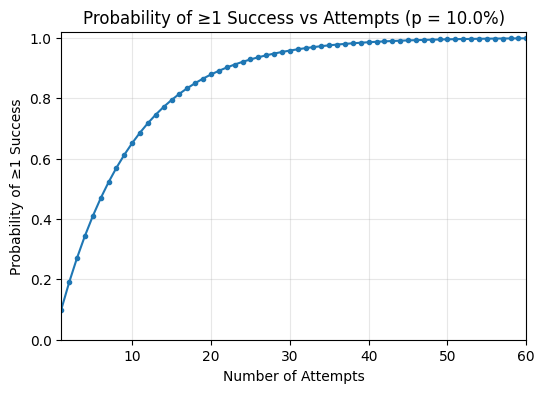
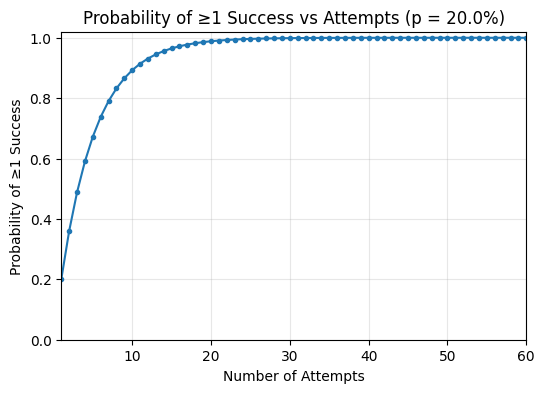
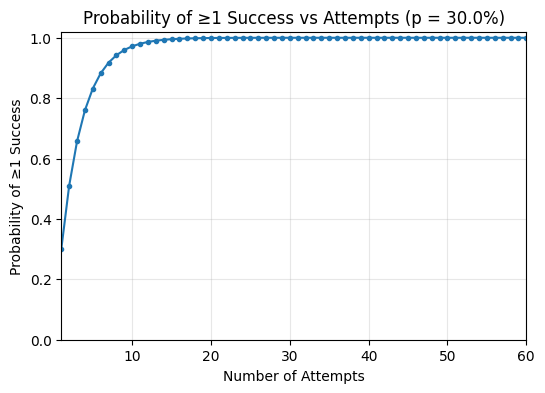
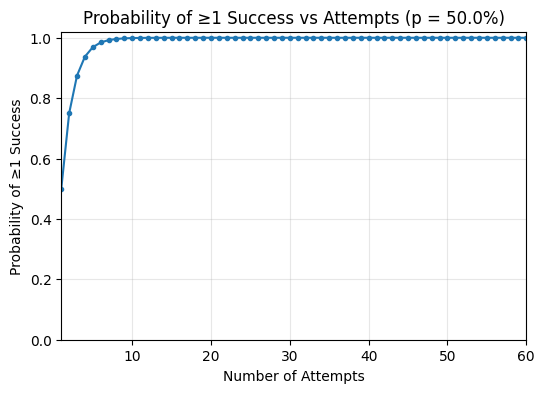
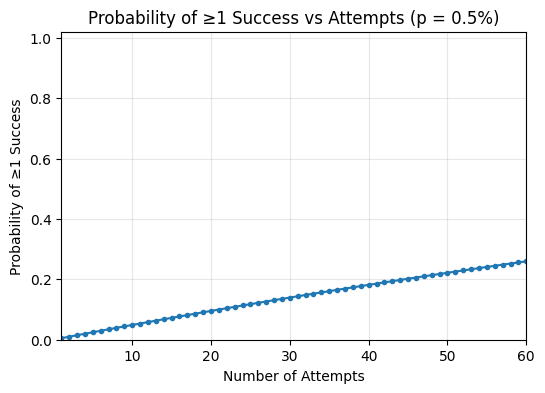
Each graph shows the probability of at least one business reaching $10,000 MRR across multiple attempts — where p is the per-attempt success rate.

Show 0.5%

Let's start with an incredibly difficult world.

Imagine only 0.5% of business ideas reach $10,000 MRR.

That sounds hopeless.

But mathematics still rewards repeated attempts.

Probability of at least one success vs attempts (p = 0.5%)

Show 1%

Now double the success rate.

Nothing else changes.

The curve immediately becomes steeper.

Probability of at least one success vs attempts (p = 1%)

Show 2%

Still a very difficult environment.

Yet repeated experimentation begins producing meaningful probabilities.

Probability of at least one success vs attempts (p = 2%)

Show 5%

Now people start recognising the curve.

Probability of at least one success vs attempts (p = 5%)

Show 10%

This is a more likely result.

Probability of at least one success vs attempts (p = 10%)

Show 20%

Now you can see that it is approaching certainty incredibly quickly.

Probability of at least one success vs attempts (p = 20%)

Show 30%

Very obvious.

Probability of at least one success vs attempts (p = 30%)

Show 50%

This almost becomes a coin flip example.

Everyone instantly understands it.

Probability of at least one success vs attempts (p = 50%)

Notice something remarkable.

Every curve has a different starting point. Every curve represents a different business environment. But every curve tells exactly the same story. More attempts increase the probability of at least one success.

That's the theorem.

It's important to understand that we've used businesses as the unit of measurement because it's the simplest way to demonstrate the mathematics.

The same principle applies at every level of entrepreneurship.

A business is simply a collection of experiments.

Every marketing campaign.

Every product improvement.

Every pricing test.

Every AI Employee.

Every customer interaction.

Every automation.

Each one is another attempt to improve the business.

The entrepreneur who can perform more high-quality experiments at a lower cost gains a mathematical advantage over time.

That's why No More Staff isn't just about helping you launch more businesses.

It's about helping you build businesses that can learn, improve and evolve faster than their competitors.